







Contact our team of experts.
Technical Documentation Service Provider – Professional Support
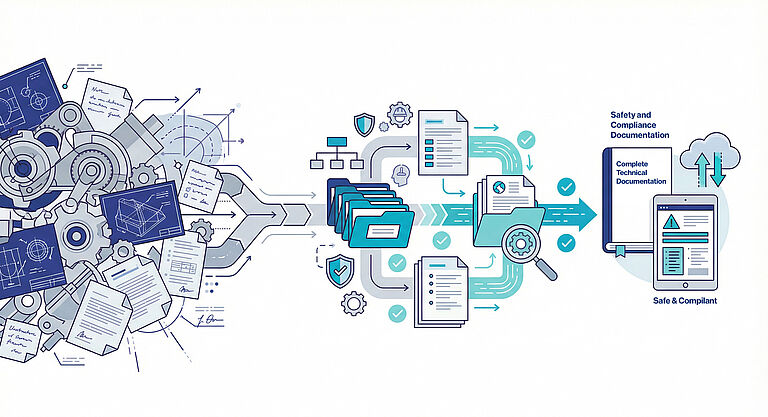
As an experienced technical documentation service provider, we assist companies in creating standard-compliant documentation that enables the safe use of machines and systems. Complete, carefully prepared technical documentation forms the backbone of modern product communication: it protects users, supports service technicians in maintenance and repair tasks, and plays a key role in avoiding liability risks. At the same time, it increases transparency throughout the entire development process and facilitates communication between design, service, and sales.
Our team develops customised documentation concepts that are precisely tailored to the respective machine and the desired area of application. The work is based on in-depth research into standards, detailed research discussions, and the evaluation of supplier documentation. This results in high-quality documents that are technically accurate, compliant with standards, and easy to understand. Depending on the scope of the project, the documentation may include elements such as operating instructions, maintenance instructions, assembly documentation, technical data, or validation documents.


Technical Documentation Service Provider –
Content, Methods, and Working Practices
As a technical documentation service provider, we rely on close cooperation between editors, engineers, and service technicians. Our aim is to develop documents that not only comply with standards but are also formulated in a practical manner. To achieve this, we use modern editing systems, maintain structured data, and ensure consistent content throughout.
Our typical range of services includes:
- Creation of standard-compliant instructions
- Risk assessments and evaluation of technical solutions
- Measurement and test reports
- Validation documents and certificates
- Service literature for maintenance and commissioning
- Structured documentation concepts for long-term maintenance and expandability
This approach ensures high quality in technical communication and makes the entire product life cycle easier for companies – from development to after-sales service.
Technical Documentation Service Provider –
Efficient Process through Structured Approach
To ensure that documentation does not become a burden but rather supports the development process, we place great importance on clear procedures. Every technical documentation project begins with an inventory: What documents are available? Which standards apply? Which target groups are being addressed? The next step involves research discussions with designers and service technicians, followed by the systematic evaluation of supplier documentation.
The result is technical documentation that meets all legal and normative requirements while remaining easy to understand. Companies that have their technical documentation created benefit from faster implementation, precise content, and a significant reduction in the burden on internal resources.
Outsourcing Technical Documentation –
taking the Pressure off your Development Department
Outsourcing technical documentation offers clear advantages: internal teams gain more freedom, projects can be completed faster, and documents are produced to a consistently high standard. For many companies, outsourcing technical documentation is a strategic decision to bridge personnel bottlenecks or incorporate technical expertise. At the same time, they benefit from structured processes, clear cost planning, and an external perspective on technical content.
Our experienced team of editors and engineers produces documentation that is compliant with standards, technically accurate, and user-friendly.
FAQs about Technical Documentation
A technical documentation refers to all written documents that enable the safe use of a product. This includes, for example, operating instructions, maintenance instructions, technical data sheets, circuit diagrams, and service literature. It serves both the user and service technicians and fulfills important legal requirements.
Complete documentation usually includes operating instructions, safety instructions, assembly instructions, maintenance instructions, technical data, test documents, risk assessments, diagrams, supplier documentation, and, depending on the product, validation documents. It is crucial that all content complies with standards, is understandable, and is complete. Equally important is a clear structure that enables users and service technicians to quickly find relevant information. Well-structured documentation also facilitates subsequent updates and supports companies in audits and certification processes.
The collaboration begins with an analysis of the existing material, followed by research discussions and a review of standards. The team then develops structural and textual documentation concepts, creates the desired documents, and ensures clear, clean, and transparent implementation. Companies benefit from high quality, reduced effort, and smooth coordination.
Many companies outsource their technical documentation because external specialists work more efficiently, follow relevant standards, and have access to professional DTP systems as well as advanced graphics or CAD tools. A professional service provider brings in-depth expertise, experience from numerous projects, and direct access to current standards and editorial systems. This results in precise, understandable, and legally compliant documents, while internal teams can concentrate on development, design, or sales. This reduces sources of error, speeds up projects, and improves the quality of overall product communication.
Standards and guidelines form the basis for all professional technical documentation. They define which content is mandatory, how safety information must be presented, and which requirements apply to a standard-compliant structure. By conducting detailed standards research, service providers ensure that operating instructions, maintenance manuals, and service literature comply with all legal requirements. This protects manufacturers from liability risks, facilitates certification processes, and ensures that users can use the product safely.
Yes, outsourcing technical documentation makes a lot of sense, especially for companies with limited resources or sporadic documentation needs. Instead of employing their own editors, smaller companies benefit from flexible collaboration, clearly calculable costs, and professional results. At the same time, they remain compliant with standards without having to set up extensive internal processes or tools such as editorial systems. In addition, they gain valuable time for their core business and can drive development projects forward without additional administrative effort. Outsourcing also gives them access to expertise that is often not permanently available internally.

Sparked your interest? Let’s talk.




© 2026 tec.nicum