







Contact our team of experts.

Use our Explosion Protection Documentation Service –
Safety for all Areas of Operation
Many companies are faced with the task of reliably identifying explosion risks and defining preventive measures.
Anyone who wants to have an explosion protection document created needs a clear structure, standard-compliant analyses, and comprehensible results. Potentially explosive mixtures occur in numerous industries – from food production to plastics and wood processing to metalworking. Even low concentrations of combustible dusts or vapors can pose a risk.
The experts at tec.nicum consulting support companies with in-depth specialist knowledge, international experience, and a practical view of all relevant processes.


Basics and Advantages of our Explosion Protection Documentation Service
A professionally prepared explosion protection document is far more than a regulatory requirement. It strengthens operational safety, reduces liability risks, and clearly demonstrates how a company manages potential hazards.
Companies that have their explosion protection document created benefit from:
- neutral assessments by experienced specialists
- structured analysis processes
- clearly formulated recommendations
- complete, auditable documents
In short, a professional document enhances internal safety and ensures legal transparency for external parties.
Precise Analysis:
Classification of potentially Explosive Areas in the Operating Environment
A key step in creating an explosion protection document is the thorough classification of potentially explosive areas. Our experts consider all process steps in which flammable gases, vapors, or dusts can be generated. It is not only crucial to know that potentially explosive atmospheres occur, but also how often, under what conditions, and with what accompanying factors. This detailed analysis clearly shows where special attention is required in the plant and how high the risk in each area must be assessed. It thus forms a solid basis for all technical and organisational measures that are subsequently planned and documented.
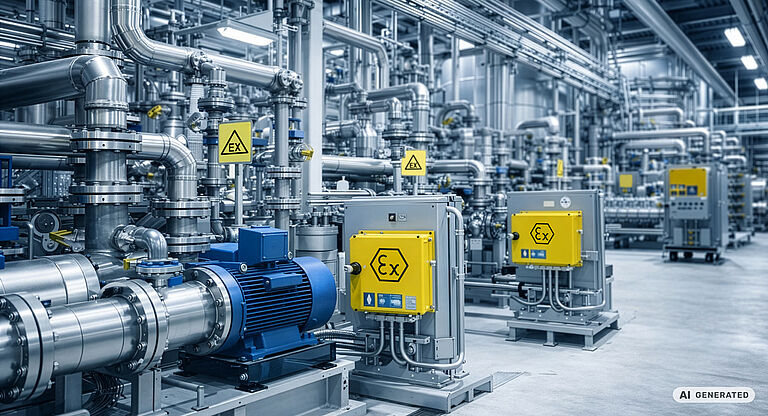
Targeted Protection planning through Precise Zoning
Standard-compliant zoning is crucial for correctly assessing risks and deriving the right protective measures. Our specialists analyse how often explosive atmospheres can occur, how long they remain, and which material properties are relevant. At the same time, operational processes, plant configurations, and spatial characteristics are also taken into account in the assessment. This results in a clear, comprehensible picture of the hazard area, which serves both technical project planning and the subsequent assignment of responsibilities. The zoning thus provides a reliable basis on which companies can plan safely and in compliance with standards in the long term.
Ex Zone Classification as the Key to Technical Protection Concepts
Ex zone classification follows internationally recognised standards such as ATEX, NEC/CEC, NEPSI, and GOST and forms the foundation of every risk-oriented protection strategy. Each zone has specific requirements—from the selection of electrical equipment and the design of work areas to testing intervals and maintenance concepts. Our experts carefully examine which technical protection measures are necessary and how they can be implemented most efficiently. Based on this assessment, a clear catalog of measures is created that both meets regulatory requirements and remains realistic for implementation in daily operations.
Creating Clarity:
Definition of Ex Zones for all Parties involved
An explosion protection document only fulfills its purpose when all parties involved intuitively understand its contents. That is why we include a precise, comprehensible definition of Ex zones that explains why a zone has been classified as such, what hazards exist, and what roles and responsibilities arise from this. This section is deliberately aimed not only at occupational safety officers, but also at service technicians, maintenance teams, and plant operators. This creates a common basic understanding that facilitates safe handling of the plant and efficiently supports subsequent training, inspections, and audits.
Have an explosion protection document created –
How tec.nicum works
Analysis and data collection
The creation process begins with a comprehensive recording of all relevant data: operational processes, substances used, spatial conditions, and existing protective measures are systematically recorded and evaluated.
Technical evaluation and consulting
Our experts analyse potential ignition sources, evaluate process steps, and compare all findings with national and international standards. On this basis, we develop specific recommendations for technical and organisational measures.
Documentation of measures
The scope of services includes, among other things:
- Identification, description, and classification of potentially explosive areas (zone classification)
- Complete documentation of all protective measures
- Technical project planning in potentially explosive areas
- Validation of equipment in accordance with international specifications
- Clear recommendations for action for safe plant operation
Companies that have their explosion protection document prepared receive a standard-compliant, transparent, and practical document that both meets audit requirements and supports safe operation in the long term.
FAQs about the Explosion Protection Documentation Service
An explosion protection document is always required if substances, vapors, gases, or dusts are present in the workplace that could ignite and thus pose a potential explosion hazard. This obligation arises from the Industrial Safety Regulation and applies to almost all industries in which explosive atmospheres can occur.
In principle, an explosion protection document may only be created if sufficient expertise in explosion protection is available. In practice, this is often done by external specialists, safety engineers, or expert consultants such as tec.nicum consulting, who have proven expertise in national and international explosion protection regulations
A complete explosion protection document includes a description of the work areas, the classification of potentially explosive areas, the zoning, the assessment of ignition sources, technical and organisational protective measures, and comprehensible documentation of all results. Depending on the company, it may also include process descriptions, test concepts, maintenance instructions, or validation documents.
In Europe, explosion protection is primarily based on the ATEX Directive, the Industrial Safety Regulation (BetrSichV), and relevant standards such as DIN EN 60079. These regulations define the measures that employers must take and how potentially explosive areas are to be classified.
An explosion protection document is not a static document. It must always be updated when processes, substances, plant concepts, or workflows change. New findings, malfunctions, or test reports may also necessitate a revision.
In principle, any company where combustible dusts, gases, or vapors may occur—regardless of industry or company size. These include, for example, food processing plants, paint shops, plastics processors, mills, metalworking companies, and chemical companies.
In addition to explosive atmospheres, the document analyses typical ignition sources such as hot surfaces, sparks, electrostatic discharges, mechanical friction, and electrical equipment. It assesses the likelihood of an explosion and the measures that can be taken to prevent it.
The document describes technical, organisational, and structural measures such as ventilation, grounding, ignition source prevention, zoning, selection of suitable equipment, and employee training. It specifies how safety is to be ensured in the long term.

Sparked your interest? Let’s talk.





© 2026 tec.nicum