
Contact our team of experts.
LiDAR scan
Precise documentation as the basis for successful modernisation
When modernising and retrofitting machines, it is crucial to have precise knowledge of the existing inventory. Our 3D scanning services of machines and industrial installations ensure that you have the complete, high-resolution data required to plan a conversion in a technically safe, economically viable, and timely manner. Modern LiDAR scanning technology provides a reliable basis for this – quickly, efficiently, and with great attention to detail.
LiDAR (Light Detection and Ranging) uses laser-based distance measurement to generate 3D point clouds of real objects. This data maps the real machine, its structure and environment with millimetre accuracy. In the context of retrofitting projects, this opens up completely new possibilities for planning, collision detection, digital twin creation and the safe integration of new components.


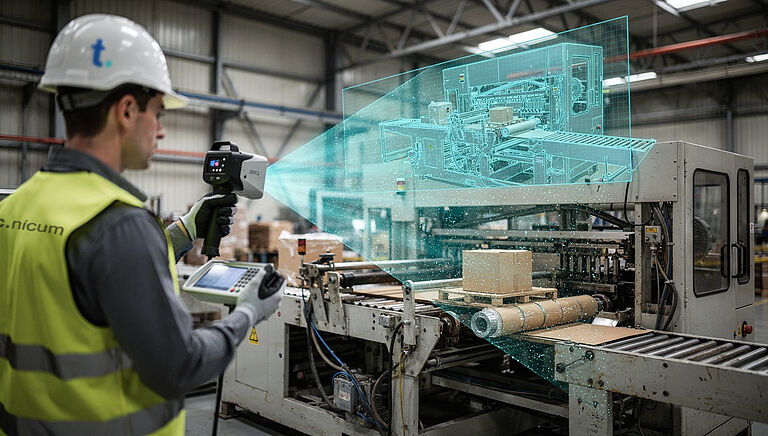
Areas of application and benefits of a LiDAR Scan
Fast and cost-efficient capture – Instead of time-consuming measurement
Traditional surveying methods are time-consuming and labour-intensive. LiDAR scanning significantly reduces the effort involved. With portable scanners, existing machines can be completely captured in no time at all – without production downtime or extensive preparations.
The data provided by a LiDAR scan can also support the updating of HMI visualisations. This allows for a perfect alignment between the physical installation on the shop floor and the digital interface used by operators and maintenance teams.
Digital inventory models
as the basis for all engineering steps
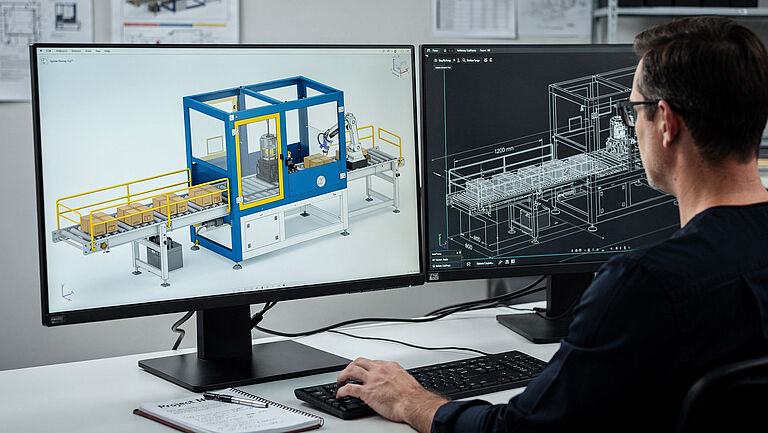
Our 3D scanning services of machines and industrial installations provide the raw high-precision data needed to create "as-built" 3D models. These digital representations can be transferred directly into your existing CAD systems, ensuring that your engineering team works with 100% accurate data rather than outdated blueprints.
These precise models serve as the essential foundation for:
- Design of New Assemblies: Developing components that fit perfectly into the existing machine structure.
- Analysis of Space Conditions and Tolerances: Evaluating exact measurements to ensure all new parts comply with tight spatial constraints.
- Visualisation of Modifications: Previewing planned changes in a realistic 3D environment before any physical work begins.
- Comprehensive Collision Checks: Identifying and resolving potential physical interference between old and new components.
- Simulation-Based Feasibility Analyses: Running virtual tests to confirm that the modernisation will work as intended under real-world conditions
Increasing safety and planning quality
through precise data
By utilizing a LiDAR scan, we create a detailed virtual image of the real-world machine, allowing potential risks to be identified and eliminated during the earliest planning stages. This "digital twin" approach ensures that incorrect dimensions, unrecognised obstacles, or unplanned connections become visible long before any costly components are manufactured or assembled.
The result is a significantly higher level of planning reliability. Our 3D scanning services of machines and industrial installations help you avoid expensive mid-project corrections and ensure that the final implementation is both safe and technically sound.
Workflow:
From Precision Scan to Completed Modernisation
The path to a modernized plant shouldn't be a guessing game. By using our 3D scanning services of machines and industrial installations, we transform your physical factory into a high-precision digital environment through five clear stages:
We define the "Scan Targets" and select the best hardware—whether handheld scanners for tight spaces or stationary systems for large-scale industrial installations
Our team performs the actual LiDAR scan. This is fast and contactless, meaning your production keeps running while we capture the "as-built" geometry with millimetre accuracy.
The raw "Point Cloud" (the millions of laser dots) is cleaned, segmented, and converted. This turns messy raw data into a clean, CAD-compatible format your engineers can actually use.
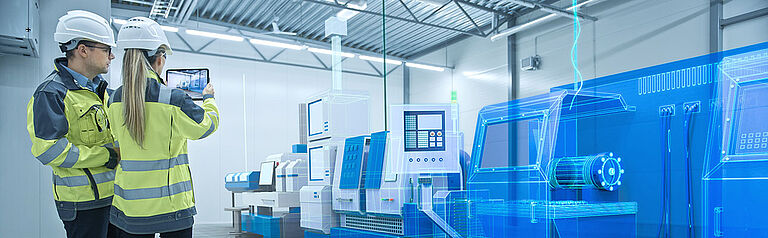
In this stage, the digital twin comes to life. We use the model for collision checks and simulations, ensuring that new components fit perfectly into the existing space before they are even built.
The physical installation. Because we planned everything based on a 100% accurate 3D model, the final assembly is fast, safe, and fits the first time—verified by our reference data.
Your Key Advantages at a Glance
Choosing a professional LiDAR scan for your project offers more than just measurements—it provides a strategic edge for your entire engineering lifecycle. Benefit from:
- Maximum Accuracy: Eliminate guesswork with high-precision inventory data of your machines.
- Time and Cost Efficiency: Save resources compared to traditional, manual surveying methods.
- Seamless System Integration: Direct data flow into your existing CAD and PLM processes.
- Early Risk Mitigation: Identify planning errors and obstacles before they cause costly delays.
- Versatile Hardware Solutions: Flexible data capture using handheld or stationary scanning systems.
- Sustainable Data Foundation: Today’s scan becomes a valuable asset for all future plant modifications.
- Lifecycle Future-Proofing: Easily adapt and modify your machinery with a reliable digital record.
LiDAR Scan:
Future-proof your projects with our professional 3d scanning services
A LiDAR scan is far more than just a surveying tool—it is a strategic component for modern retrofitting and sustainable machine modernisation. By digitally mapping real-world environments and transferring them into the engineering process, you increase planning reliability, reduce technical risks, and significantly accelerate your projects.
Our 3D scanning services of machines and industrial installations provide the perfect foundation for your success. Plan your next modernisation precisely and safely based on a high-fidelity digital twin.
Talk to us today about using a LiDAR scan for your next retrofitting project.

Sparked your interest? Let’s talk.




© 2026 tec.nicum