





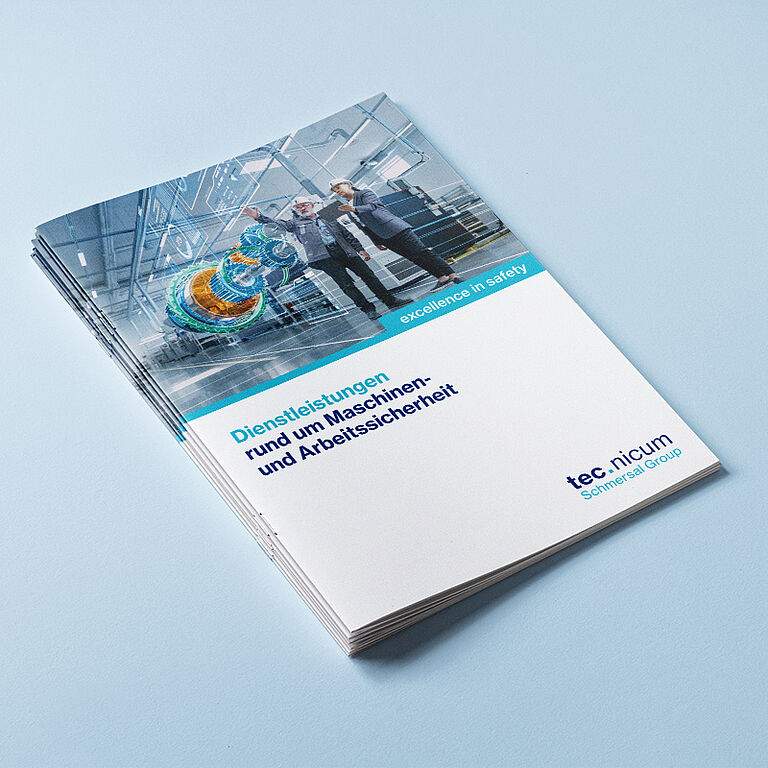
Our new brochure

DIN EN ISO 12100
DIN EN ISO 12100, “Safety of machinery – General principles for design – Risk assessment and risk reduction”, is the central basic standard for mechanical engineering.
It belongs to the so-called Type A standards and forms the basis for many other standards in the field of machinery safety.
Aim and Purpose of the Standard
DIN EN ISO 12100 describes the general principles according to which machines must be designed so that they are safe for users. Its focus lies on the systematic performance of risk assessment and the measures required for risk reduction. It therefore provides the foundation on which all further safety-related considerations are built.
Contents of DIN EN ISO 12100
The standard defines a clearly structured process for risk assessment:
- Defining the limits of the machine
(intended use, service life, operating conditions)
- Identification of hazards
(mechanical, electrical, thermal, ergonomic, etc.)
- Risk estimation
(analysis of severity, frequency and possibility of avoidance)
- Risk evaluation
(decision on whether further measures are required)- Risk reduction
- Inherently safe design
- Technical protective measures
- User information (warnings, operating instructions)
Application and Validity
DIN EN ISO 12100 is harmonised under the Machinery Directive and, in future, also under the Machinery Regulation.
Its application gives rise to the presumption of conformity: manufacturers who implement the requirements of the standard demonstrably fulfil the essential safety requirements of the Directive or Regulation.
It is applicable to all types of machinery and serves as a universal guideline, regardless of the industry or specific application.
Relevance in Practice
DIN EN ISO 12100 provides clarity: it shows that machinery safety does not depend solely on technical protective measures, but begins as early as the design and planning stage. Owing to its universal character, it serves as a kind of “common language” for developers, designers and safety engineers.
tec.nicum offers an extensive programme of seminars and training courses on this subject area.



© 2026 tec.nicum