







Our new brochure

EN ISO 13849-1
DIN EN ISO 13849-1, “Safety-related parts of control systems”, is one of the most important standards for functional safety in mechanical engineering. It belongs to the Type B1 standards in accordance with DIN EN ISO 12100 and defines requirements for safety-related parts of control systems (SRP/CS – Safety Related Parts of Control Systems).
Aim and Purpose of the Standard
The standard describes how safety-related control components must be designed and assessed in order to achieve a defined level of safety.
The focus is on determining the required Performance Level (PLr) for each safety function and demonstrating that this level is achieved through appropriate measures.
Contents of DIN EN ISO 13849-1
The standard combines architecture-based requirements with statistical parameters and describes a structured assessment process:
- Determination of the required Performance Level (PLr)
using a risk graph with the parameters severity of injury (S), frequency of exposure to the hazard (F), and possibility of avoiding the hazard (P) - System design and component selection
taking into account control categories, MTTFd (mean time to dangerous failure), DCavg (average diagnostic coverage), and CCF (common cause failure) - Validation of the safety function
through technical evidence, testing and documentation
Current Edition and Changes
The revised edition DIN EN ISO 13849-1:2023-12 has been in force since December 2023, replacing the previous 2016 edition.
Key changes include:
- Clearer terminology and harmonised requirements
- Extended scope of application for modern control technologies
- Updated references to other standards, e.g. on functional safety
- Integration of validation (previously Part 2) into the main body of the standard
- New requirements for the Safety Requirements Specification (SRS), software and EMC
Application and Validity
The standard is harmonised under the Machinery Directive and, in future, also under the Machinery Regulation.
Its application gives rise to the presumption of conformity: compliance is regarded as evidence that the essential safety requirements have been fulfilled. The standard is referenced by many Type C standards and is relevant for a wide range of machine types.
Relevance in Practice
DIN EN ISO 13849-1 must be applied whenever machine control systems perform safety-related functions – for example emergency stop, guard locking, protective door monitoring, light curtains, or safety controllers for robots.
It supports manufacturers in systematically assessing and reliably implementing safety functions – from risk analysis through to validation.
SISTEMA
With this tool, users can model the structure of safety-related control components based on the specified architecture, enabling automatic calculation of reliability values at different levels of detail, including the achieved Performance Level (PL). The SISTEMA software is available in English and German.
SISTEMA can also be downloaded free of charge here and distributed to third parties.
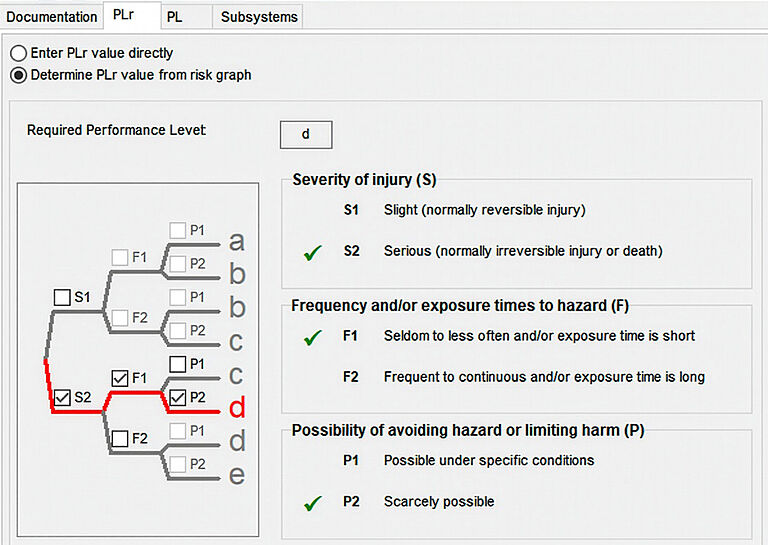
Relevant parameters – such as the risk parameters for determining the required Performance Level (PLr), the category, measures against failures due to common causes (CCFs) in multi-channel systems, the average component reliability (MTTFd), and the average diagnostic coverage (DCavg) of components and blocks – are entered step by step into templates. Once the required data have been entered in SISTEMA, the results are calculated and displayed immediately.
A practical advantage for users is that any change to a parameter is instantly reflected on the screen, including its impact on the entire system. The software takes over the time-consuming task of looking up values in tables and performing calculations (e.g. calculating the MTTFd using the “parts count method”, symmetrising the MTTFd for each channel, estimating the DCavg, calculating PFH and PL, etc.). This enables users to vary parameter values and assess the impact of changes with minimal effort.
The final results are printed in a report.



© 2026 tec.nicum