





Our new brochure

Modernisation of machinery
Retrofit and Assessment of Substantial Modifications
As a general principle, the Machinery Directive – and in future the Machinery Regulation – applies to new machinery. However, if an existing machine is modified to an extent that gives rise to new or changed hazards, it must be assessed whether a substantial modification has taken place. In such cases, the same requirements apply as for new machinery – including conformity assessment and CE marking.
Assessment of Substantial Modifications
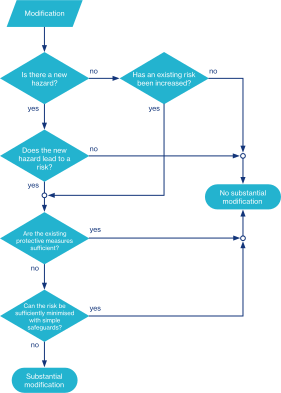
Whether a modernisation is to be classified as a “substantial modification” depends on several factors:
- new or altered hazards arise,
- existing protective measures are no longer sufficient,
- a new safety-related control system is required,
- the safety concept must be fundamentally adapted, and
- the risks cannot be controlled by simple technical measures.
If one or more of these conditions apply, a substantial modification must be assumed. The machine must then be treated as a new machine.
A simple technical measure is deemed to exist if:
- no new hazards arise,
- the existing safety control system is sufficient,
- there is no fundamental change to the function or intended use, and
- the risk can be controlled by simple protective measures (e.g. a guard, light curtain).
In such cases, no new CE marking is required.
Modernisation of machinery
Normative Basis and Current Requirements
DIN EN ISO 13849-1:2023-12 does not contain any direct provisions for the assessment of modernisations. However, it refers to the need for a complete risk assessment and validation in the event of safety-related changes – regardless of whether a machine is new or modernised.
Even in the case of simple technical measures, it must be verified that existing safety functions remain effective. If this is the case, an update of the risk assessment is sufficient. A new declaration of conformity and CE marking are only required if the modification is classified as a substantial modification.
Recommendation for Practice
Before any modernisation, a structured analysis should be carried out to assess whether safety-relevant changes are involved and whether a substantial modification is present.
In cases of uncertainty, the involvement of tec.nicum is recommended. As a partner within the network, tec.nicum provides manufacturer-independent consultancy, supports risk assessment activities and assists with the standards-compliant implementation of safety measures – both for new developments and retrofit projects.
The experts at tec.nicum support companies throughout all phases of a machine’s life cycle: from planning and documentation through to practical implementation – always with the aim of delivering a safe and economically viable solution.



© 2026 tec.nicum