








Our new brochure

Performance Level (PL)
A key element of the standard is the Performance Level (PL). It describes the probability of a dangerous failure per hour and is divided into five levels, from PL a (low) to PL e (high). The selection of the required PL (PLr) is based on a risk graph that considers three parameters:
S: Severity of injury
S1: Slight (usually reversible) injury
S2: Serious (usually irreversible) injury, including death
F: Frequency / duration of exposure to the hazard
F1: Seldom to more often, short duration of exposure
F2: Frequent to continuous, long duration of exposure
- F1 may be selected if the accumulated exposure time does not exceed 1/20 of the overall operating time and the frequency is not higher than once per 15 min.
- F2 should be selected if the exposure time is 4 times per hour, or more.
P: Possibility of avoiding the hazard
P1: Possible under certain conditions
P2: Hardly possible.
- P1 or P2 is chosen after consideration of the five parameters in table A.1 and A.2 of Annex A in EN ISO 13849-1:2023.
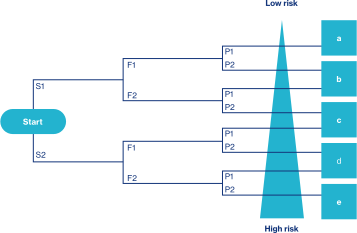
Determination of the Required PLr for a Safety Function in Accordance with ISO 13849-1
System Design and Component Selection
In order to achieve the required PLr, control systems must be appropriately designed and suitable components selected. The standard takes the following technical criteria into account:
- Control Categories
These describe the structural design of the system (e.g. Category B, 1, 2, 3, 4) and define requirements for fault behaviour and diagnostic capabilities. - MTTFd (Mean Time to Dangerous Failure)
Indicates the average time until a dangerous failure of a component occurs. The higher the value, the more reliable the component. - DCavg (Average Diagnostic Coverage)
Describes how effectively the system detects dangerous faults. A high diagnostic coverage improves the safety assessment. - CCF (Common Cause Failure)
Assesses the probability of common cause failures, for example due to environmental influences or design faults. Measures to reduce CCF are required in order to achieve high PL levels.
Validation of the Safety Function
The achievement of the required PLr must be confirmed by appropriate technical evidence. This includes:
- Calculations and simulations
- Inspections and testing
- Documentation of the architecture and characteristic values
Only through the combination of systematic assessment, appropriate design and careful validation can the required level of safety be reliably achieved.
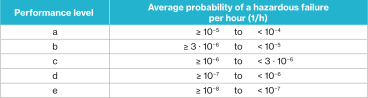
Performance Level
Guidelines for Selecting the Levels of S, F and P for Risk Estimation
Severity of Injury (S1 or S2)
When making the decision, the typical consequences of accidents and normal recovery processes must be taken into account in order to determine S1 or S2. For example, bruises and/or cuts without complications are classified as S1, whereas amputation or death is classified as S2.
Frequency and/or Duration of Exposure to the Hazard (F1 or F2)
- F1: May be selected if the total exposure time does not exceed 1/20 of the total operating time and the frequency is not higher than once every 15 minutes.
- F2: Unless other circumstances apply, F2 should be selected if the frequency is higher than once every 15 minutes.
Possibility of Avoiding the Hazard (P1 or P2)
When a hazardous situation occurs, P1 should only be selected if there is a realistic chance of avoiding the accident or significantly reducing its consequences. P2 should be selected if there is almost no chance of avoiding the hazard. P1 or P2 is chosen after consideration of the five Parameters in Table A.1 and A.2 of Annex A in EN ISO 13849-1:2023.
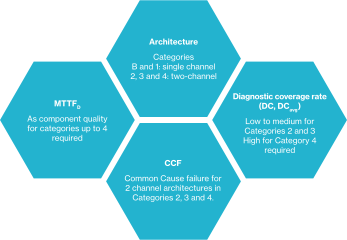
Characteristic Values and Parameters for Determining the Performance Level (PL) of a Safety Function
Each individual safety function of a machine resulting from the risk assessment must be considered and analysed, for example emergency stopping (emergency stop), guard locking of movable guards, etc.
The PLr is the result obtained from evaluating the risk graph.
The achievable PL can be attained through various combinations of safety parameters, namely the selected Category (Cat.) and the determined values for MTTFd, DC and CCF.
For a PL “e”, for example, the following parameters are required:
Category 4, MTTFd value “high” and DC value “high”.
If, however, the target for the required risk reduction is to achieve PLr“c” or “d”, different design options are available.
For example, for PL “c”, a configuration in accordance with Category 1, a single-channel MTTFd-value “high” and a DC value “None” may be selected. Alternatively, a configuration in accordance with Category 3, a two-channel MTTFd-value “Medium” and a DC value “Low” can also be considered.
The CCF factor must always be taken into account with architectures from Category 2 onwards.
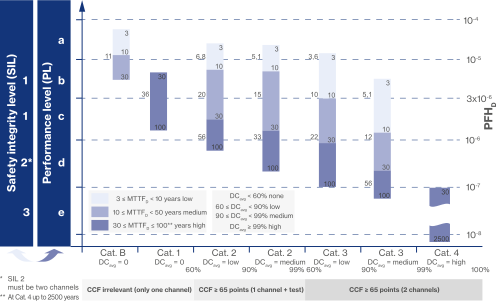
Relationships Between Characteristic Values and Parameters for Determining the PL in Accordance with EN ISO 13849-1



© 2026 tec.nicum