





Our new brochure

Risk assessment
Carrying out a risk assessment is mandatory under the Machinery Directive and the new Machinery Regulation. It forms the basis for CE marking and is defined as a prerequisite for placing machinery on the market.
DIN EN ISO 12100 specifies this process in normative terms and provides a systematic approach to the identification, evaluation and reduction of risks.
The risk assessment process consists of several steps:
- Defining the limits of the machine (intended use, spatial and temporal limits, materials, energies).
- Identifying hazards (moving parts, electrical hazards, ergonomic risks, etc.).
- Estimating risks (severity of possible injury, frequency of exposure, possibility of avoidance).
- Evaluating risks and deciding whether risk reduction measures are required.
- Eliminating hazards or reducing risks through inherently safe design, technical protective measures or user information.
Risk assessment is an iterative process – it is repeated until risks have been reduced to an acceptable level.
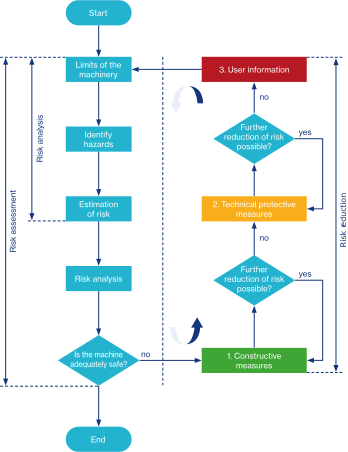
Presentation of risk assessment and the iterative process for risk reduction. Based on EN ISO 12100
Identification of Hazards and Hazardous Situations
The identification of hazards is the most important step in any risk assessment. Only once a hazard has been recognised is it possible to take measures to reduce the associated risk. When identifying hazards (e.g. moving parts, laser radiation) and hazardous situations (e.g. working in the vicinity of moving parts, working in noisy environments, activities such as assembly or maintenance), the checklists in Annex B of EN ISO 12100 provide valuable guidance.
Risk Estimation
For each identified hazard, a risk estimation must be carried out (how high is the risk?). On this basis, the need for risk reduction measures is derived during risk evaluation. Risk estimation is one of the most challenging steps, and a wide range of methods is available for this purpose.
The experts at tec.nicum use the HRN system (Hazard Rating Number) developed by Chris Steel for risk estimation. The advantage of the HRN system is that it is an internationally recognised method that delivers highly differentiated results.
Risk Evaluation
At this stage of the risk assessment, a decision must be made: is the risk acceptable, or are risk reduction measures required? The HRN ranking used by tec.nicum provides decision support, on the basis of which priorities can be set for any necessary protective measures.
Elimination of Hazards or Risk Reduction
For the elimination of hazards or the reduction of risks associated with these hazards, Machinery Directive 2006/42/EC mandates a three-step approach:
- Inherently safe design
- Technical protective measures
- User information
Inherently safe design can only be implemented during the planning and development phase, as it involves protective measures that either eliminate hazards entirely or at least reduce them by modifying the design or operating characteristics of the machine without the use of guarding or protective devices. This step is therefore carried out first, as experience shows that inherently safe measures remain effective, whereas technical protective measures are more likely to fail or be circumvented.
For technical protective measures, a wide range of guarding and protective devices is available – such as safety fences or safety light curtains – which can be designed and applied according to the type of hazard.
User information includes acoustic or visual warning signals, warning notices, operating instructions and markings that draw attention to residual risks.



© 2026 tec.nicum